
by Dr. Nils Jean
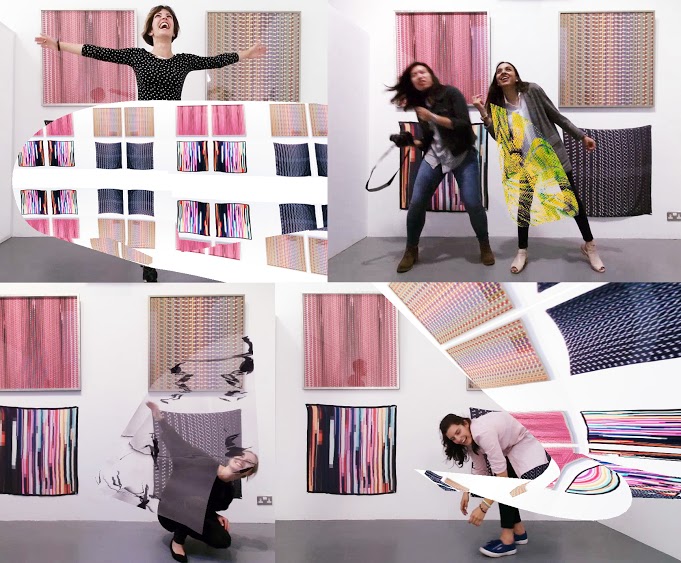
I enter the room, set up with an enigmatic installation comprised of a laptop on a table, a sensor box on its side and a white screen mounted above it. The screen displays a fragment of a 24 seconds video capture from Jodi’s website Asdfg, which I have submitted for the experiment. Then I’m told to stay three metres away from the sensor box and to walk towards it; and, without knowing it, I’ve entered the space of Asdfg’s video. The frames of the video, which have been ingeniously transformed into a cube, are now surrounding me. By moving my arm, my leg or just the tip of my fingers I can distort, merge and expand the faces of the cube I temporarily inhabit. Like in a half digital and half imaginary house of mirrors, I become the master of the illusion. Here Yen-Ting Cho writes a form of visual score for the participant to not only conduct but create.
At this moment a ubiquitous occurrence takes over me: on the one hand, the visual experience of contemplating the textures of the cube in an almost anamorphic manner and, on the other hand, the body movements which are actually generating the image. A memory of Yat Malmgren’s theories on acting then led me to realise that those two phenomena are in dialogue within the space of the MovISee cube. Malmgren’s account of the cube as a visualising device enabling the actor to transform language into gestures, somehow resonate with MovISee, where language is substituted for the information contained in the video file and invites the participant to experiment with gestures.
What strikes me in MovISee is how the medium proposed is not only real-time and site-specific but also performative, in as much as, on a conceptual level, the installation builds up a succession of ideas for it self, thus creating a bespoke mixed-media space. Indeed, it seems that the originality of the installation resides in its capacity to build a sequence of different media, which could all stand in their own right but, which here, are sequenced in a dynamic logic where each medium informs the previous one. The different media encompassed in MovISee – the video, its cubic transformation, the performance of the participant which generates a moving image in real time, the performance which becomes a spectacle in itself, the printed record of the experience on fabric – illuminates the previous medium with new meanings. As such, the printed fabric acts as an abstract snapshot of the performance, where the folds of the material recall the folds of the moving image created by the participant.
Dr. Nils Jean
Nils Jean is a writer in Media Aesthetics. Trained as a designer, he also holds an M.A. (Distinction) in Visual Culture from the University of Westminster and a Ph.D. in Communication from the Royal College of Art, London. His research revolves around expressions of the ephemeral, the use of information as a material and language.