
by Cathy Rogers
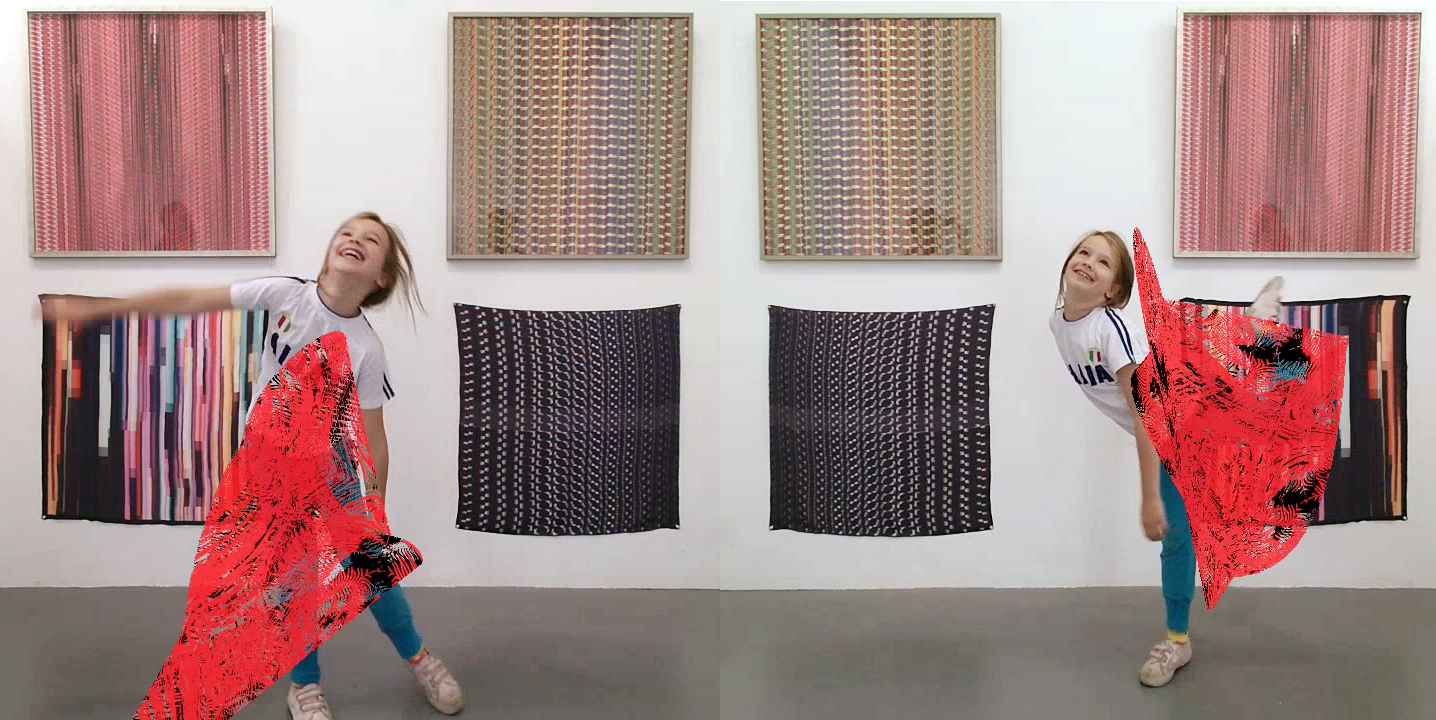
Engaging with MovISee was exciting as I was given the opportunity to interact with one of my short videos, shot on a mobile phone, in a completely new and inimitable way. I was presented with my source footage, but not in a way I recognised, and encouraged to use the whole body to expand, shrink and skew it by big arm, leg and torso gestures. This interaction is completely different to a game environment where you are given a set environment to navigate through; by contrast, MovISee is presented in an abstract form and remains so throughout – all known associations with the sources representational imagery are collapsed.
I remember feeling a little awkward at first and self-conscious about the shapes I would have to move my body into in order to re-activate the image through MovISee. The self-consciousness arose due partly to the awareness that I, the user, was completely in control of manipulating the image. I soon became engrossed and focussed on making the form shift and distort without really paying attention to what shape my body made. However, there is not a disassociation between body, image and physical ‘real’ space as all three become inter-related through the act of performance. I remember at the time wondering the ‘what if’ possibilities of MovISee: could you walk into this digital space, whole body immersed? However, conceptually and physically this is nothing like virtual reality; instead, this is a synergy between mind, body and physical space fully engaged in the act of shaping your own ‘constructed’ digital reality. Virtual reality replaces the physical location of the body with a sealed pre-constructed digital space activated by the use of glasses, visually separating you from sight of your body and its physical real time location.
MovISee dissolves this separation and becomes part of the landscape/space where you are physically located. In fact, virtual reality does precisely the opposite to MovISee, which reverses the motion of the body synced to a pre-configured computerised landscape to the body movement defining the image whilst still connected to a physical real time space/location. In this way, virtual reality confines the experience of digital space primarily to the mind and dislocates us from the continuity of physical space/location and time as we are transported elsewhere, whereas MovISee holistically re-joins body, mind, physical space and time.
Besides the philosophical enquiries (time/space, real/virtual, body/mind) MovISee raises, it is exciting to consider what its potential future applications might be.
Cathy Rogers
Cathy Rogers is an artist and writer working with Super 8 and 16mm film within expanded cinema contexts. She has recently completed an MPhil research degree at the Royal College of Art, titled ‘Film Outside Cinema’. Her work has been published in Sequence 2, 2011, London, written about by Nicky Hamlyn in ‘Medium Practices’, Public Journal, Issue 44, York University, 2010, Toronto and cited in A.L Rees essay ‘Physical Optics: a return to the repressed‘, Millennium Film Journal, Fall 2013, New York. Recent installations and events include: Fieldwork II, Disruption, Here and Now, Nightworks, Living Film, Film|Performance|Space, ‘Assembly: A Survey of Recent Artists’ Film and Video in Britain 2008-2013’, Dyad at Roomartspace, London and Black & Light at Apiary Studios. Cathy is currently writing an article about Contemporary Expanded Cinema for a new festival and publication in London in 2016.