
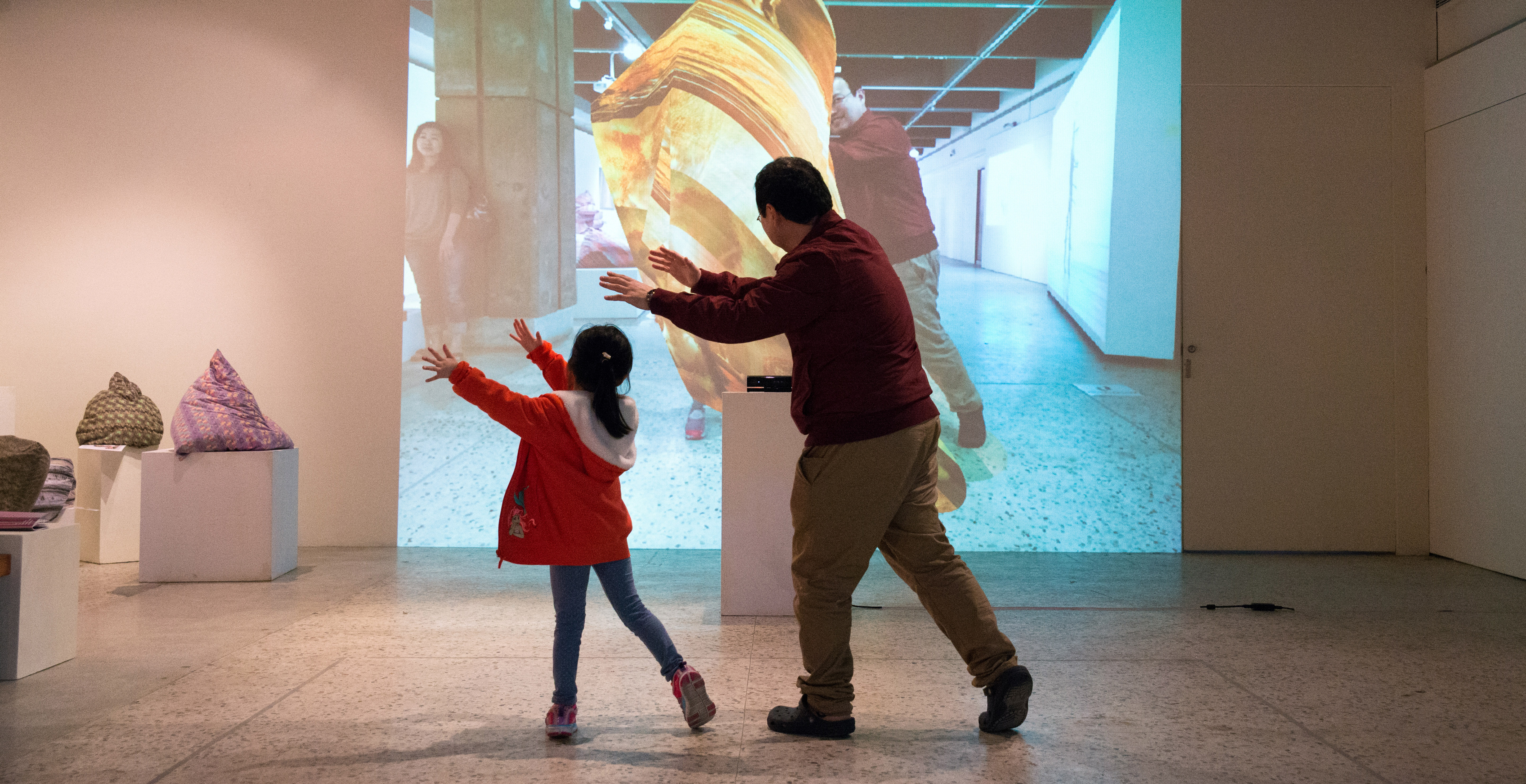
Through designing MovISee, we explore the question of how participants’ experience is shaped by the medium and how the medium enhances their indi-viduality by encouraging them to create their ways of seeing. In this manner, the medium becomes our content. Our ultimate aim has been to design a digital moving image medium in which participants are able to choose what and how they want to explore, rather than to design a relationship between the participants’ actions and the desired response.
Designing a new medium is not the same as designing interaction because the former focuses on the frame-work into which participants can input their own content and interact in their own ways, and does not limit what and how the participant’s want to reflect. It is not a matter of building relationships between specific input(s) and output(s). As a result, in MovISee, the participant actively chooses the input data (both the video and the body movement), makes a decision about their objective(s) for using the medium, and decides on a strategy to meet the objective(s).
Sasha Barab, Melissa Gresalfi, and Adam Ingram-Goble argue that transformational playing integrates person, content, and context to form a transactive system in which each of the three elements motivates and is motivated by the others. 1 We further argue that MovISee is a model of participation that involves intentionally leveraging the three interconnected elements of viewer (person), input video (content), and medium (context). In MovISee, the viewer is responsible for making choices that advance the navigation within the video. The chosen input video by participants fills the cube with the content of their interests ripe for exploring. MovISee as a medium provides a context that is modifiable through participants’ choices and their body movements, thus illuminating the consequences of their decisions. Therefore, the participants transcend what is known (their body movements and chosen input video) in the current state to form new moving image results as well as ideas for experimenting with their body movements, and shape and re-shape them.
1. Barab, S. A., Gresalfi, M. and Ingram-Goble, A. (2010) ‘Transformational Play: Using Games to Position Person, Content, and Context’, Educational Researcher, 39 (7), 525-536.