
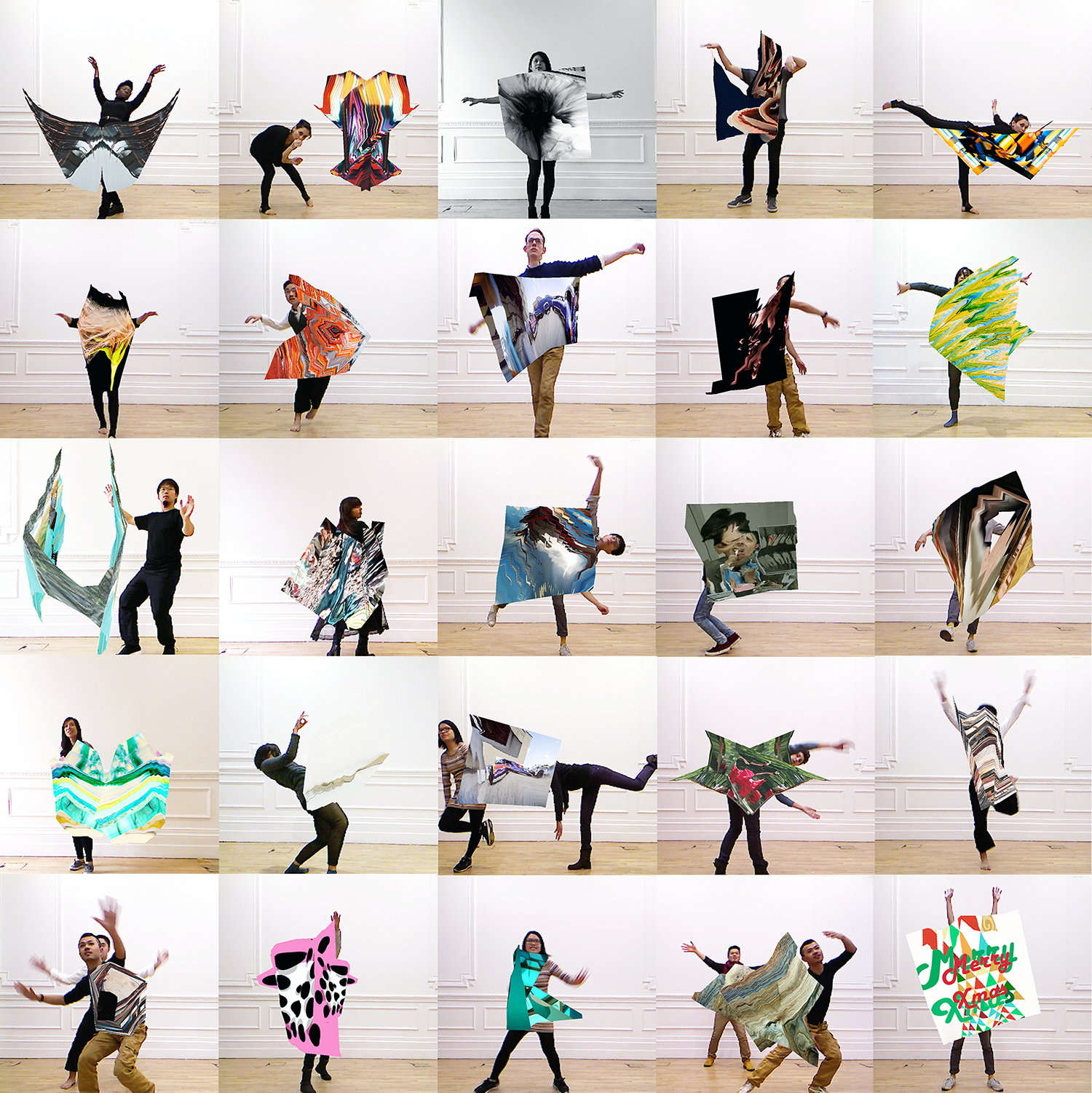
MovISee makes possible a new way of seeing the recorded visual data and shows that navigating within the cube leads to new experience. A participant can use his/her body to revisit and recreate the recorded moving images. When revisiting the recorded data, the cube is like a room which is structured interiorly by the input video selected by the participant. The latter then chooses an angle to enter the room and physically travels through it, non-linearly. If a participant only wants to explore within the cube, his/her body movements generate numerical data through a depth sensor to create a sequence of different frames. If a participant has a clear goal, such as retrieving an object or creating a certain pattern, he/she often moves his/her body parts separately (dividing the projection frame), and fixes them gradually (determines the parts) until he/she is satisfied with the result (combining the parts into a whole).
With MovISee, the participants can transcend what is known (their body movements and chosen input video) in the current state to form new moving image outputs and ideas of using their body movement, and shape and re-shape them. The constant movement of the limbs generates many outputs and controls the digital adjustable lens, which the participant can use to frame and create images from what has been deconstructed. The body also serves as a remote controller to move the sequence forwards and backwards; a new path in the cube means a new sequence of the outputs.
Moreover, MovISee enables the viewers to become active participants. The participant actively chooses the input data, determines the objectives, and explores strategies to meet the objectives. The participant views something already existing through ‘shooting’ it with his/her body, and discovers its detail through creating it. MovISee therefore serves as a tool to encourage the participants’ understanding and captures their creative decisions through the exploration.